Insolight and Romande Energie inaugurate Switzerland’s largest agrivoltaic installation
Cleantech
22 September 2026
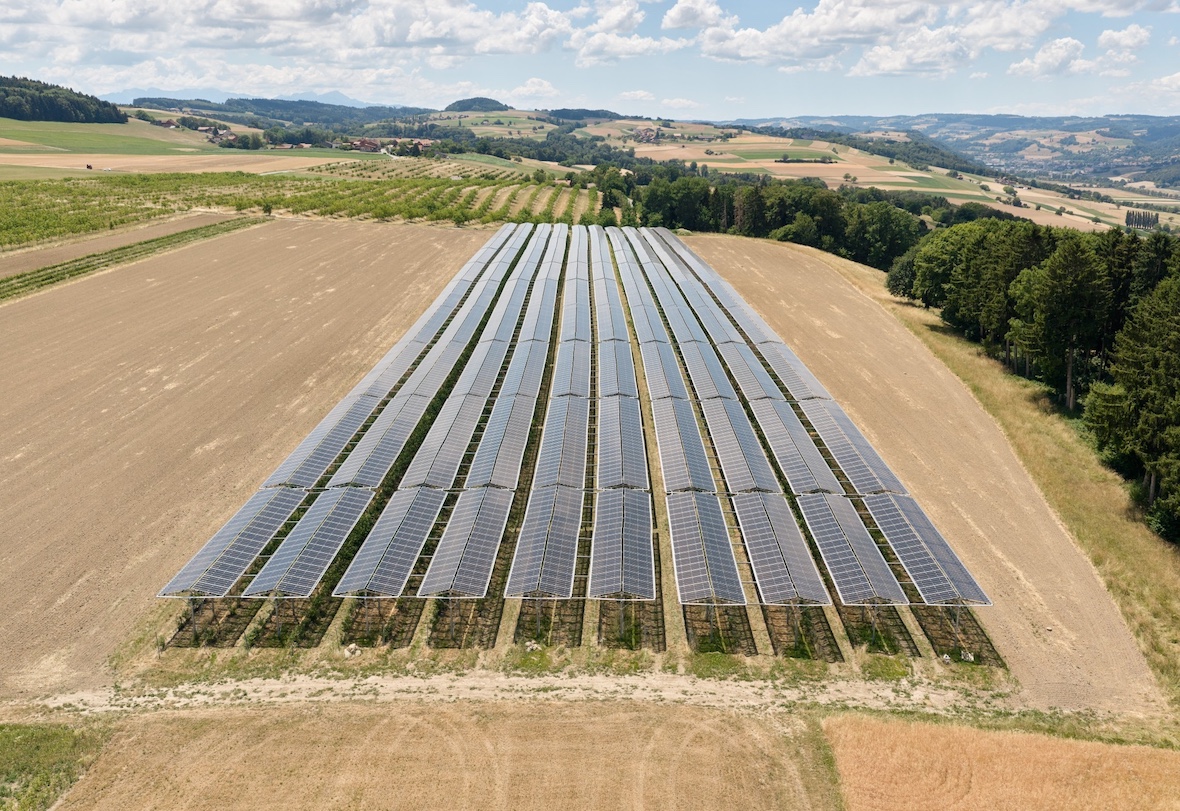 Solar panels mounted 3.2 meters above the ground shelter the organic blueberry bushes of the Lovatens agrivoltaic installation. | © Insolight | Romande Energie
In Lovatens, in the canton of Vaud, Insolight, Romande Energie and blueberry grower Olivier Pichonnat have inaugurated the largest agrivoltaic installation built in Switzerland to date, combining crop protection and renewable electricity generation on 1.8 hectares.
Insolight, Romande Energie and organic blueberry grower Olivier Pichonnat have inaugurated the largest agrivoltaic installation built in Switzerland to date, and the first in the canton of Vaud. The inauguration was attended by Vaud State Councillors Valérie Dittli, in charge of agriculture, sustainability and climate, and Isabelle Moret, in charge of the economy, innovation, employment and heritage.
The installation protects 1.8 hectares of organic blueberries under 5,220 photovoltaic panels, mounted on a structure designed specifically for the needs of the farm. Placed 3.2 meters above the ground, the panels allow the grower to keep working with his usual machinery while shielding the crops from hail, frost, heavy rain and heat waves. Annual output is estimated at 2,400 MWh, equivalent to the consumption of around 955 households.
The value of the system became evident during summer 2026. While high temperatures caused significant damage to some exposed crops, the blueberry bushes under the agrivoltaic cover benefited from markedly more favorable conditions, limiting sunburn, growth arrest and dehydration.
A turnkey model for farmers
Renens-based Insolight developed and built the installation using its Insolagrin agrivoltaic solution, drawing on projects carried out with leading agronomic research institutes. The company handles the entire authorization process, from regulatory preparation through to commissioning.
Romande Energie is financing the installation and will operate and maintain it for 30 years. The energy company also markets the solar electricity produced and integrates it into the energy system. Under this contracting model, the farmer gains climate protection for his crops and a diversified income without bearing the infrastructure investment, its management or the risks of an increasingly complex electricity market.