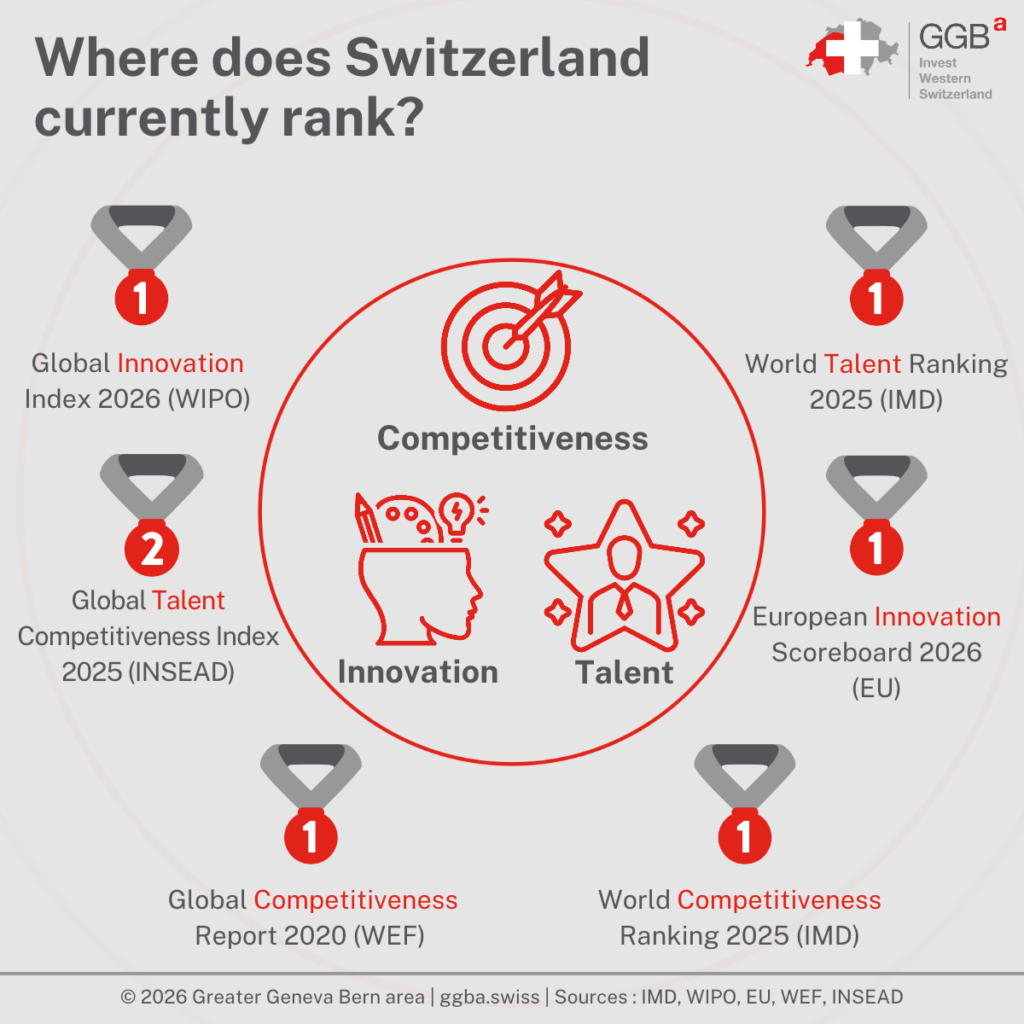
Switzerland ranks first in the Global Innovation Index for the 16th consecutive year
Business environment
5 October 2026
 Switzerland ranks first among 139 economies in the Global Innovation Index 2026, published by WIPO. | © WIPO
Switzerland has topped the World Intellectual Property Organization’s Global Innovation Index 2026 for the 16th year in a row, ahead of Sweden and the United States, in an edition devoted to deep science entrepreneurship.
Switzerland has retained its position as the world’s most innovative economy in the Global Innovation Index (GII) 2026, published by the World Intellectual Property Organization (WIPO). It is the 16th consecutive year at the top, following last year’s first place. Sweden and the United States again rank second and third, followed by the Republic of Korea and Singapore.
The index covers 139 economies using around 80 indicators. According to WIPO’s country profile, Switzerland ranks first in innovation outputs and second in innovation inputs, as last year, and first among the 39 economies in Europe. It leads worldwide in knowledge creation, creative outputs and innovation linkages, and ranks first for international patent filings relative to GDP.
The profile also highlights players from Western Switzerland. EPFL ranks 22nd in the world in the QS university ranking and first among Swiss universities for its combined industry and international outlook score in Times Higher Education data. Geneva-based SonarSource heads the list of Swiss unicorns by valuation, at USD 4.70 billion, while Lausanne-based MindMaze ranks third among the country’s most valuable deep science spinouts.
Deep science takes center stage
This year’s special theme, “Powering entrepreneurs at the frontier of science”, examines deep science entrepreneurship: start-ups and spinouts built on scientific and engineering breakthroughs in fields such as advanced materials, energy, genomics and quantum technologies, which need more time and capital to reach the market than digital ventures. The analysis finds that no other major country has more venture-backed deep tech companies per capita than Switzerland.
The report also puts this strength in perspective. The United States and China account for 89 of the 100 most valuable deep tech companies founded since 2000, and the number of deep tech start-ups grew by just under 60% in Switzerland between 2020 and 2025, compared with almost 300% in Estonia. The report recommends, among other measures, funding the missing layers between research grants and scalable private capital and activating demand from large buyers and governments.