EPFL and CSEM set world record for triple-junction solar cell efficiency
Cleantech
18 March 2026
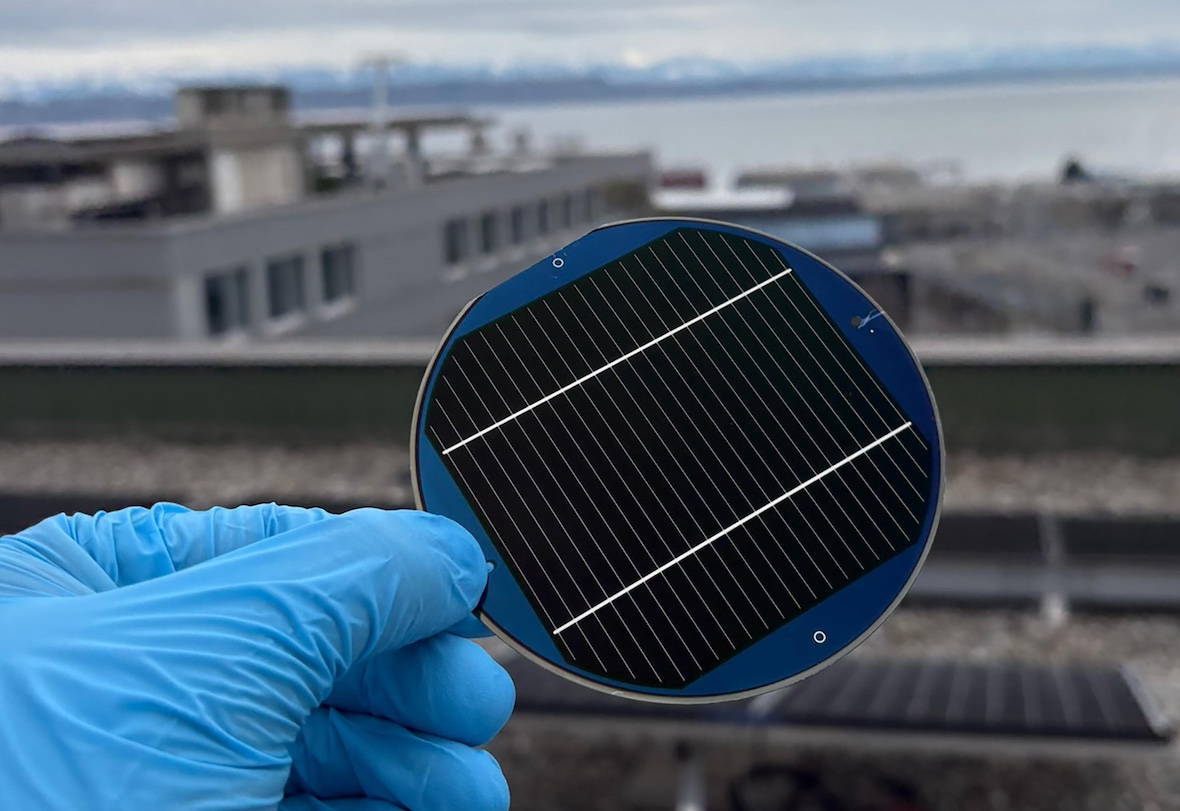 The triple-junction solar cell (54 cm²) developed jointly by EPFL and CSEM, combining two thin-film perovskite cells and one silicon cell in a single device. | © Kerem Artuk
Researchers from EPFL’s Neuchâtel-based PV Lab and CSEM have achieved a certified 30% power conversion efficiency for a triple-junction solar cell, setting a new world record and opening the door to affordable next-generation photovoltaics for terrestrial and space applications.
Researchers from EPFL‘s Photovoltaics and Thin-Film Electronics Laboratory (PV-Lab) and CSEM have set a new world record in solar cell efficiency, achieving an independently certified power conversion efficiency of 30.02% for a triple-junction solar cell. The result, published in Nature, surpasses the previous certified record of 27.1% and marks a significant milestone in the global race toward high-efficiency, low-cost photovoltaic technology.
The device combines a silicon bottom cell with two thin-film perovskite cells deposited on top, forming a triple-junction architecture that captures a broader range of the solar spectrum than conventional single-junction or tandem cells. The team addressed two longstanding limitations of this architecture, insufficient voltage in the top cell and limited current generation in the middle cell, through three targeted innovations: a molecule that guides perovskite crystal formation and eliminates defects, a new fabrication method improving near-infrared light absorption, and nanoparticles that reflect additional sunlight back into the middle cell to boost current output.
The achievement is particularly significant because both perovskite and silicon are substantially cheaper to manufacture than the III-V semiconductor cells currently used in space applications, which reach up to 37% efficiency but cost around 1,000 times more per watt. The new architecture approaches space-grade performance at a fraction of the cost, with the research team noting a potential pathway to industrially viable multi-junction photovoltaics for utility, residential, and space applications.
The result builds on a decade of sustained Neuchâtel-based photovoltaic research at CSEM and EPFL, which have previously set records in perovskite-on-silicon tandem cell efficiency. CSEM, a cornerstone of the canton’s precision technology and cleantech cluster, will continue exploring scale-up strategies and durability testing with EPFL toward commercial integration.
The research received support from the European Union’s Horizon program, the Swiss Federal Office of Energy, the Swiss National Science Foundation, and the State Secretariat for Education, Research and Innovation (SERI), reflecting the broad institutional backing behind Switzerland’s solar innovation push.