PAVE Space raises USD 40 million to accelerate satellite deployment
Tech
30 March 2026
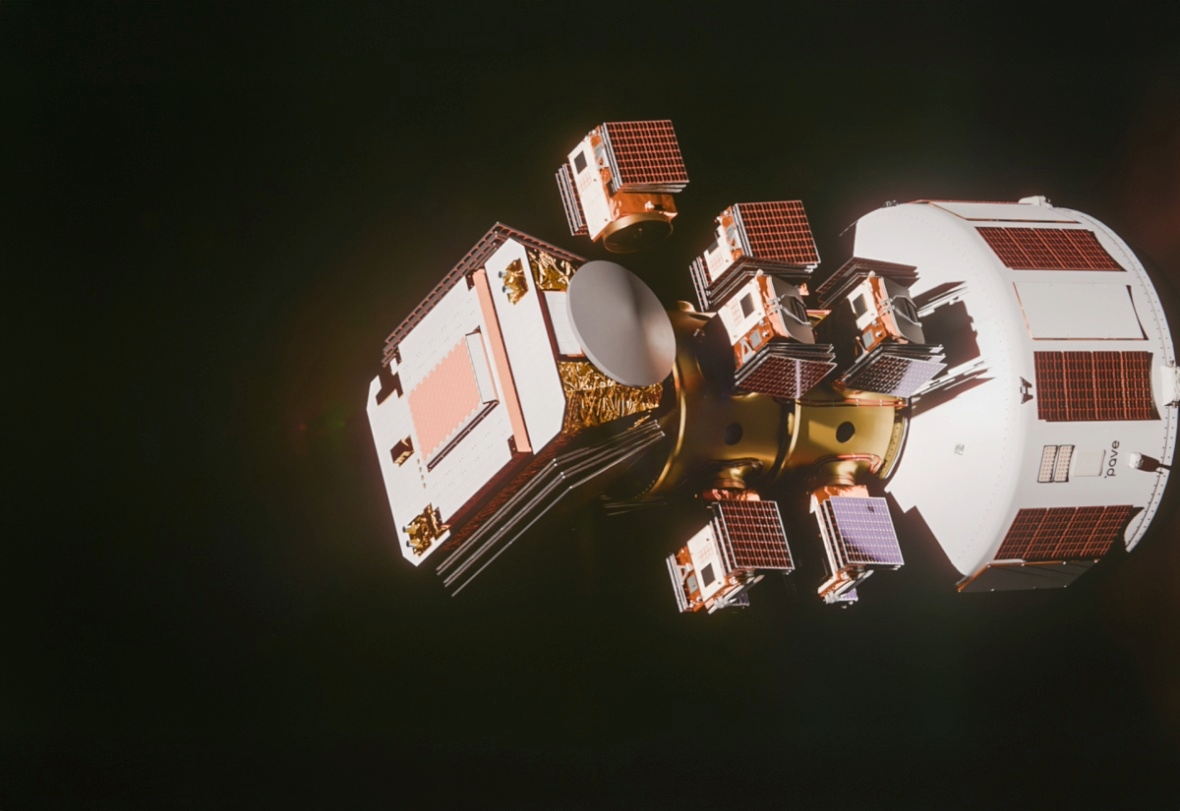 PAVE Space’s orbital transfer vehicle is designed to transport satellites from low Earth orbit to their final operational orbit in less than 24 hours, replacing a process that currently takes six to twelve months. | © PAVE Space
PAVE Space, an EPFL spin-off developing orbital transfer vehicles, has raised USD 40 million in seed funding to advance its technology and execute its first in-space demonstration mission.
Lausanne-based space infrastructure company PAVE Space has raised USD 40 million in seed funding to develop a new generation of orbital transfer vehicles (OTVs) capable of moving satellites rapidly between orbits. The round was led by Visionaries Club and Creandum, with participation from Lombard Odier Investment Managers, Atlantic Labs, Sistafund, b2venture, ACE Investment Partners, Ilavaska Vuillermoz Capital, and Pareto & Motier Ventures. It ranks among the largest seed financings in the global space sector in recent years.
Founded in 2024 by CEO Julie Böhning and CTO Jérémy Marciacq, both EPFL engineers and co-founders of the Gruyère Space Program, the first European student-led reusable rocket initiative, PAVE Space is building the infrastructure to address one of the emerging logistical bottlenecks of the rapidly expanding space economy.
Today, most launch vehicles deliver satellites only to low Earth orbit, from which spacecraft must rely on electric propulsion to reach their final orbit, a process that can take six to twelve months and delay revenue generation. PAVE’s flagship LYOBA heavy-lift kick stage is designed to complete that journey in under 24 hours, carrying payloads of up to 5 tons to geostationary orbit, medium Earth orbit, or lunar trajectories.
From the Alps to orbit
The company develops propulsion systems, avionics, control algorithms, and structural components internally, enabling rapid engineering cycles and tight platform integration. It has already converted a former Alpine power plant in Valais into a dedicated propulsion test facility, where its first rocket engine firings are planned for later this year.
A first in-space demonstration mission, GRAZE, is scheduled for October 2026 to validate the company’s avionics architecture in orbit. Commercial momentum is building: PAVE has secured eight reservation agreements with satellite operators and manufacturers and is engaged with several major industry players.