Bern-led project CHEOPS discovers rule-breaking rocky planet
Tech
17 February 2026
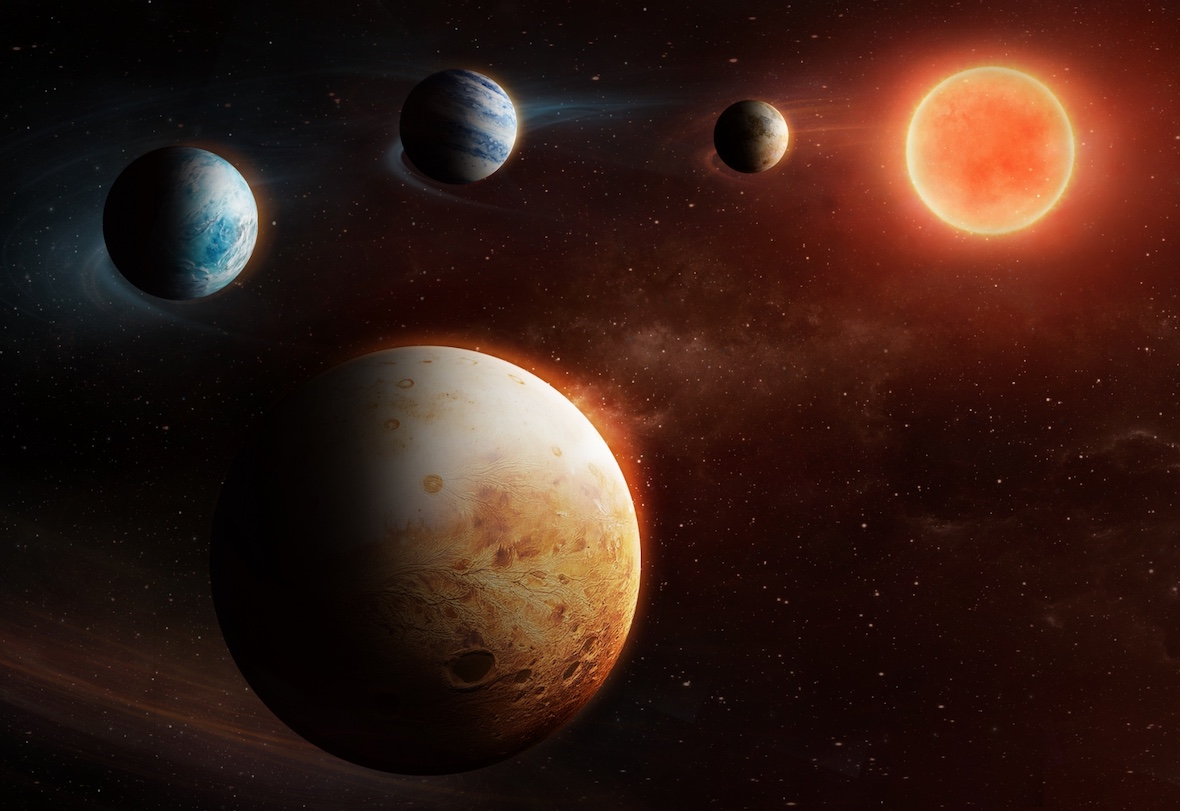 Artist impression of the planetary system around the star LHS 1903. | © ESA
CHEOPS has identified an unexpected rocky planet beyond gas giants, challenging current planetary formation models.
Researchers from the University of Bern have played a central role in a new discovery by the CHEOPS space telescope that challenges established theories of planetary formation. The mission has identified a rocky planet orbiting beyond gas giants in the planetary system around the red dwarf star LHS 1903, located 116 light-years from Earth.
In most known planetary systems, including our own Solar System, rocky planets form close to their host star, while gas giants occupy more distant orbits. However, the newly detected planet, LHS 1903 e, appears to defy this pattern. Positioned beyond two gas giants, it should theoretically have accumulated a thick gaseous envelope. Instead, observations indicate it is predominantly rocky.
The discovery was made possible thanks to the exceptional photometric precision of CHEOPS, a joint mission of the European Space Agency and Switzerland led by the University of Bern in collaboration with the University of Geneva. Bernese researchers, including experts from the Space Research and Planetary Sciences Division and the National Centre of Competence in Research PlanetS, contributed both observational expertise and planetary formation modeling.
Simulations developed at the University of Bern suggest that the outer rocky planet likely formed later than its neighboring gas giants, after the protoplanetary disk had already lost most of its gas. This scenario supports the theory of “inside-out” planet formation, in which planets form sequentially rather than simultaneously.
The finding highlights Bern’s long-standing leadership in space research and planetary science. Since its launch in 2019, CHEOPS has continued to refine understanding of exoplanet diversity, reinforcing Western Switzerland’s prominent role in European space exploration and advancing knowledge of how planetary systems form and evolve.