Empa in Thun splits into two labs for materials and metals
Tech
7 September 2026
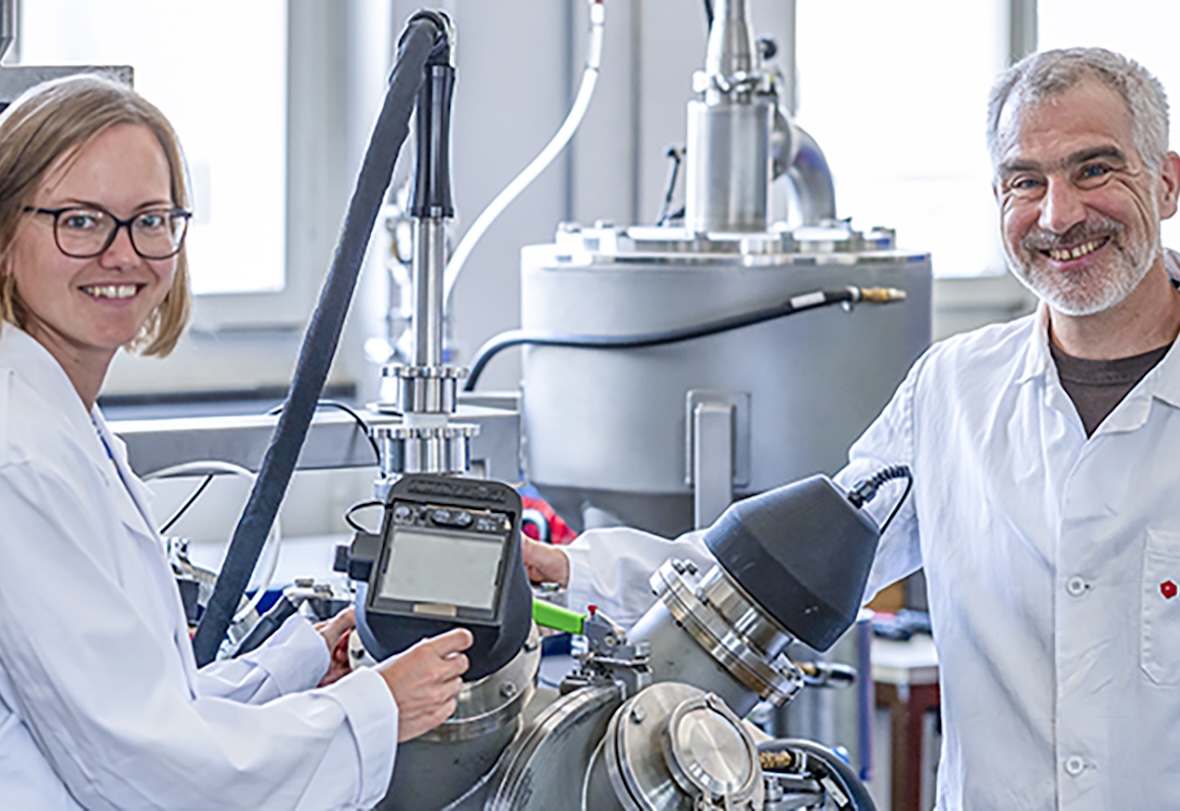 Barbara Putz and Christian Leinenbach, who took over as heads of the two newly created laboratories in Thun on 1 August 2026. | © Roland Richter, Empa
The Empa campus in Thun has split its Advanced Materials Processing laboratory into two independent units dedicated to surfaces and interfaces on one side and to metallic materials and manufacturing on the other, as researchers on the site make computational tools for alloy design accessible through a conversational AI agent.
The Empa campus in Thun, in the canton of Bern, has opened two new laboratories: Multifunctional Materials and Interfaces, and Advanced Metallurgy and Manufacturing of Metals. Both result from the split, on August 1, of the former Advanced Materials Processing laboratory, whose head Patrik Hoffmann is retiring after 17 years in the role. The reorganization consolidates the site’s two focus areas into independent units and provides a foundation for expanding strategic collaborations with partners including EPFL.
The Laboratory for Multifunctional Materials and Interfaces, led by Barbara Putz, works on the fabrication, processing and characterization of thin films, surfaces and interfaces using vacuum and laser technology, with the aim of giving materials new functionalities. One focus is the development of programmable interfaces for composite materials, pursued under the ERC Starting Grant InterBond. These structures are designed to ensure that the components of future composite materials hold together well while remaining separable on demand, a property relevant to recycling and repair. Applications range from flexible electronics and energy conversion to space exploration.
The Laboratory for Advanced Metallurgy and Manufacturing of Metals, headed by Christian Leinenbach, develops new high-performance metallic materials and the associated manufacturing processes, with a focus on additive manufacturing. Beyond enabling complex geometries, the laboratory treats additive manufacturing as a tool for the targeted development of new materials, and aims to accelerate the design of alloys and processes by integrating manufacturing technologies more closely with data-driven methods, so that advanced metallic components can continue to be developed and produced in Switzerland.
AI agents for computational materials science
That data-driven ambition already has a concrete expression on the Thun campus. Researchers there have developed OptiMat Chat, a platform that lets scientists run the complex tools of computational materials science through a plain-language text interface. Its first virtual assistant, OptiMat Alloys, is aimed at high-entropy alloys, a class of materials made of four or more metals mixed in roughly equal proportions, whose promising mechanical, thermal and electromagnetic properties are offset by an extremely large number of possible combinations that traditional trial-and-error development cannot cover.
Developed jointly by Yang Hu, of the Thun laboratory, and Vladyslav Turlo, of Empa’s Computational Engineering laboratory, the tool addresses a practical obstacle: applying computational methods correctly requires expertise that experimental materials scientists rarely have time to acquire. At its core is an AI agent that selects the appropriate domain-specific tools, executes predefined workflows and summarizes results as publication-style figures, tables and texts, without the user needing to code or configure settings.
The researchers designed the system around reliability and traceability. Scientific outputs come from connected computational tools, databases and validated procedures rather than from the language model alone, and results are stored in a database for reuse and benchmarking. Turlo cautions that the data are intended as starting points for expert interpretation and experimental planning rather than as standalone publishable results. Further agents are planned, covering ceramics and metal oxides as well as amorphous materials.