EPFL researchers build a brain-inspired AI model that is more transparent and controllable
Tech
29 June 2026
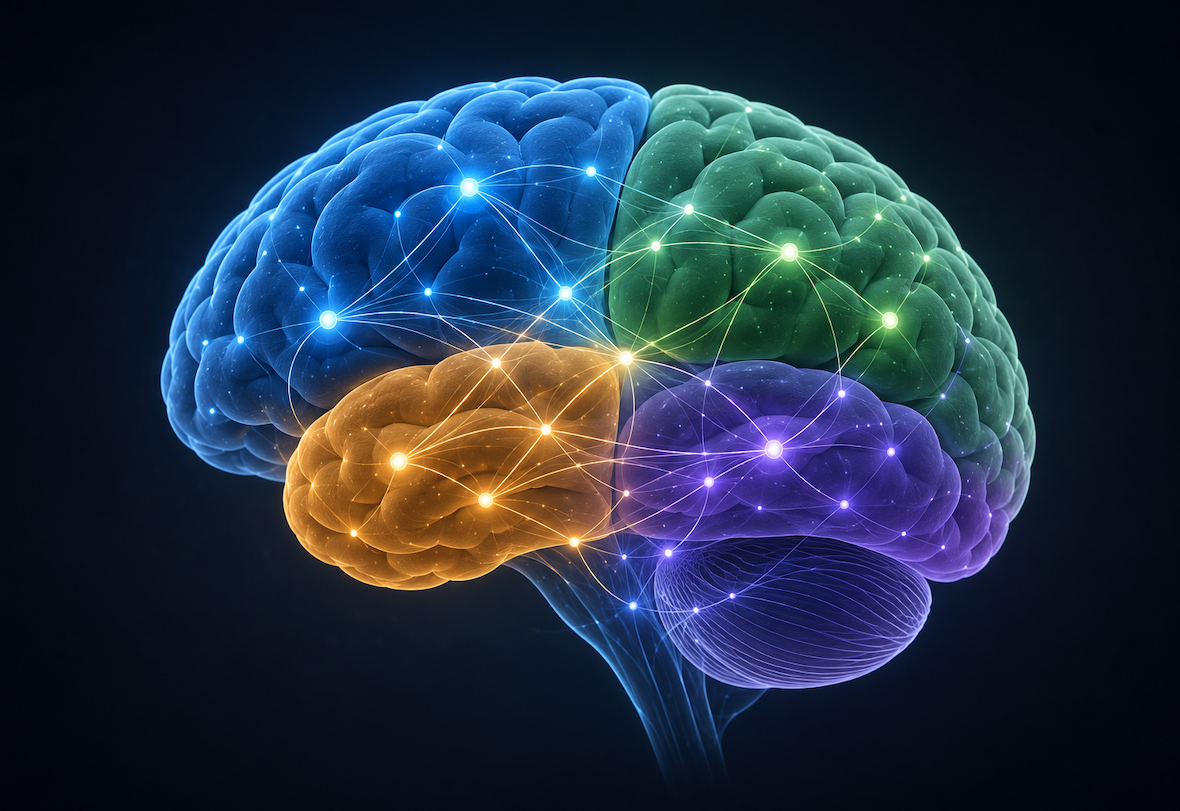 MiCRo, the large language model developed at EPFL, is divided into four specialized modules inspired by regions of the human brain.
An EPFL team has created MiCRo, a new large language model structured like the human brain, with four specialized modules that give users more control and move away from “black box” AI.
Researchers at EPFL have created a new large language model (LLM) structured similarly to the human brain, designed to give users more control and make the model’s reasoning more transparent than conventional “black box” AI. Named MiCRo (Mixture of Cognitive Reasoners), the model was presented at the International Conference on Learning Representations and developed by the NLP Lab and the NeuroAI Lab, within EPFL’s School of Computer and Communication Sciences and School of Life Sciences.
Where a standard LLM solves a problem by matching it against patterns seen in training, often in ways that are hard to interpret, MiCRo is divided into four specialized modules, or “experts,” each analogous to a region of the brain: language, logic, social reasoning and world knowledge. Within each layer of the model, a router can send each word of a sentence to the expert best equipped to handle it, so a single sentence can be processed by several experts at once.
For a prompt that mixes arithmetic with social nuance, such as splitting a dinner bill while accounting for a friend’s unspoken financial difficulty, MiCRo routes the numbers to the logic expert and the social cues to the social reasoning expert. This separation makes it easier to see how the model reaches its answers, and lets users steer its behavior by amplifying or suppressing a given expert directly in the architecture, without relying on prompting.
To build MiCRo, the team, led by PhD candidate Badr AlKhamissi, worked with neuroscientist Greta Tuckute of Harvard and MIT, applying methods used to map brain activity in humans to identify the model’s experts. The researchers describe a “virtuous circle” in which neuroscience informs AI while AI models, in turn, may help reveal how different regions of the brain contribute to a given task.