ESA extends the CHEOPS space telescope mission until 2029
Tech
15 June 2026
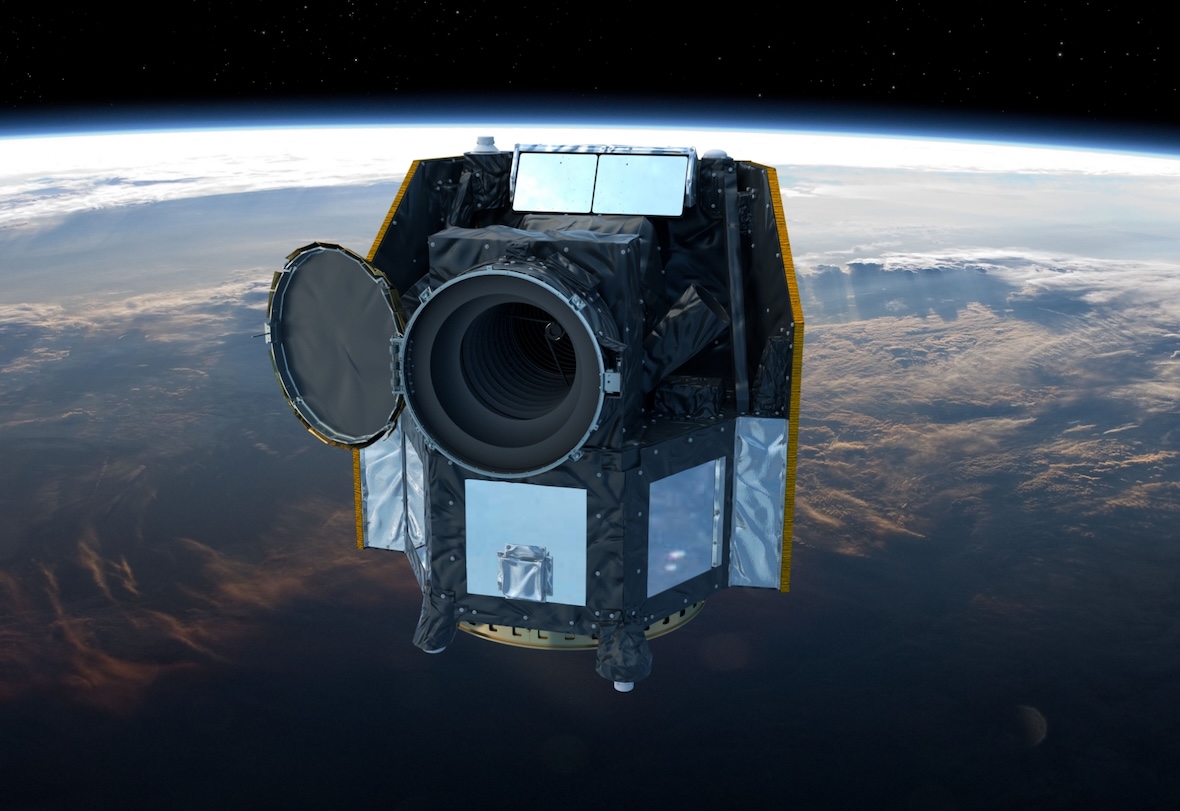 Artist’s impression of CHEOPS, the space telescope built at the University of Bern with its science operations center at the University of Geneva. | © ESA / ATG medialab
Following the strong scientific performance of the CHEOPS space telescope, the European Space Agency has extended its mission until the end of 2029, keeping its science operations center at the University of Geneva at the heart of European exoplanet research.
The European Space Agency (ESA) has decided to extend the mission of the CHEOPS space telescope until the end of 2029, citing its strong scientific performance. CHEOPS is a joint mission of the ESA and Switzerland, led by the University of Bern (UniBE) in collaboration with the University of Geneva (UNIGE), which hosts the mission’s science operations center at its Department of Astronomy.
Launched in December 2019, CHEOPS (CHaracterising ExOPlanets Satellite) measures the variations in a star’s brightness as a planet passes in front of it, allowing scientists to determine the size and density of exoplanets. The mission was first extended in 2023, and the ESA Science Programme Committee has now approved a second extension until the end of the decade.
Among its findings, CHEOPS contributed to the discovery of a planet orbiting the star LHS 1903 and detected, for the first time, the deformation of an exoplanet caused by strong tidal forces, giving it a shape closer to a rugby ball than a sphere. The telescope also operates in tandem with other missions, including the James Webb Space Telescope, identifying promising targets and characterizing exoplanets ahead of detailed atmospheric study.
Over the coming years, CHEOPS will pursue long-term observation programs, examine new planetary systems and test innovative observation methods, such as the search for exomoons and more precise measurements of planetary interiors.
The extension underscores the role of the University of Geneva and Western Switzerland in exoplanet research, a field in which the region has built deep expertise since the discovery of the first exoplanet orbiting a Sun-like star by Geneva astronomers Michel Mayor and Didier Queloz in 1995, work that earned them the 2019 Nobel Prize in Physics.