
Switzerland and the EU sign a comprehensive bilateral agreement package
Business environment
3 March 2026
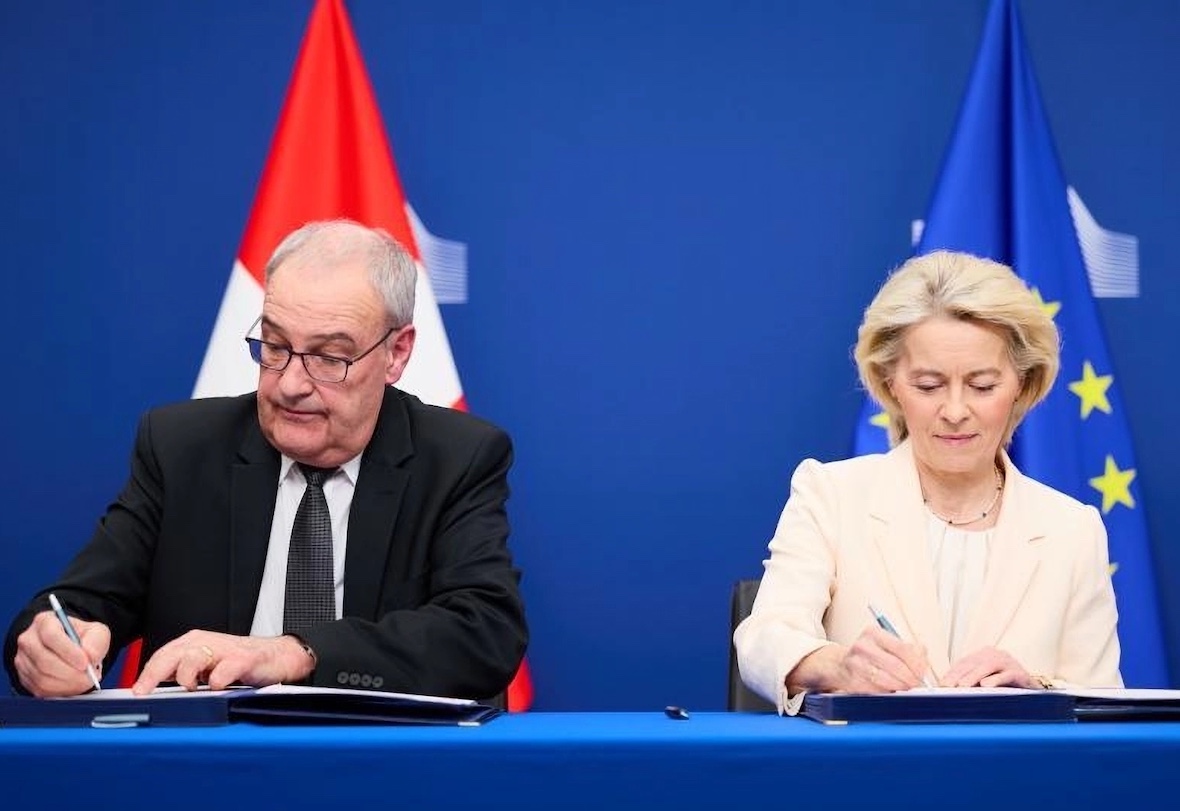 Guy Parmelin and Ursula von der Leyen at the signing ceremony in Brussels, 2 March 2026. | © European Commission
On 2 March 2026, Switzerland and the European Union signed a broad package of bilateral agreements in Brussels, establishing a modern framework designed to deepen and expand cooperation across trade, health, energy, research, and market access.
The package, referred to as Bilaterals III, was signed by European Commission President Ursula von der Leyen and Swiss Confederation President Guy Parmelin. It aims to provide frictionless access to a market of 460 million consumers in key sectors, while aligning standards and regulatory frameworks on both sides of the border. The agreements also introduce mechanisms allowing Switzerland to contribute to the development of EU legislation in areas covered by the package, giving it influence over rules that will apply to its economy.
The package updates four existing agreements, covering air transport, land transport, the free movement of persons, and mutual recognition of conformity assessments, bringing them in line with current EU standards. For companies operating across the Swiss-EU border, this modernization is designed to restore a level playing field and ensure that existing market access rights can be fully exercised.
Several new agreements are introduced. A health agreement will allow Switzerland to participate in EU mechanisms addressing serious cross-border health threats, including the European Centre for Disease Prevention and Control and the Early Warning and Response System. A food safety agreement establishes a common area covering the entire food chain, while an electricity agreement enables Swiss participation in the EU internal electricity market. A further agreement covers Switzerland’s involvement in the EU space program, specifically the Galileo and EGNOS navigation systems.
The package also incorporates the agreement on Switzerland’s participation in EU programs, which were signed separately in November 2025, which opened access to Horizon Europe, Euratom Research and Training, Digital Europe, Erasmus+, EU4Health, and ITER/F4E. That agreement entered provisional application ahead of the broader package, enabling research collaboration to begin within current work programs.
Negotiations were launched in March 2024 and concluded in December 2024. The signed package now moves into ratification, a process that will require parliamentary approval in Switzerland and consent from the European Parliament, with the possibility of a Swiss referendum.