Asinov School opens in Renens to train professionals to work with humanoid robots
Tech
13 October 2026
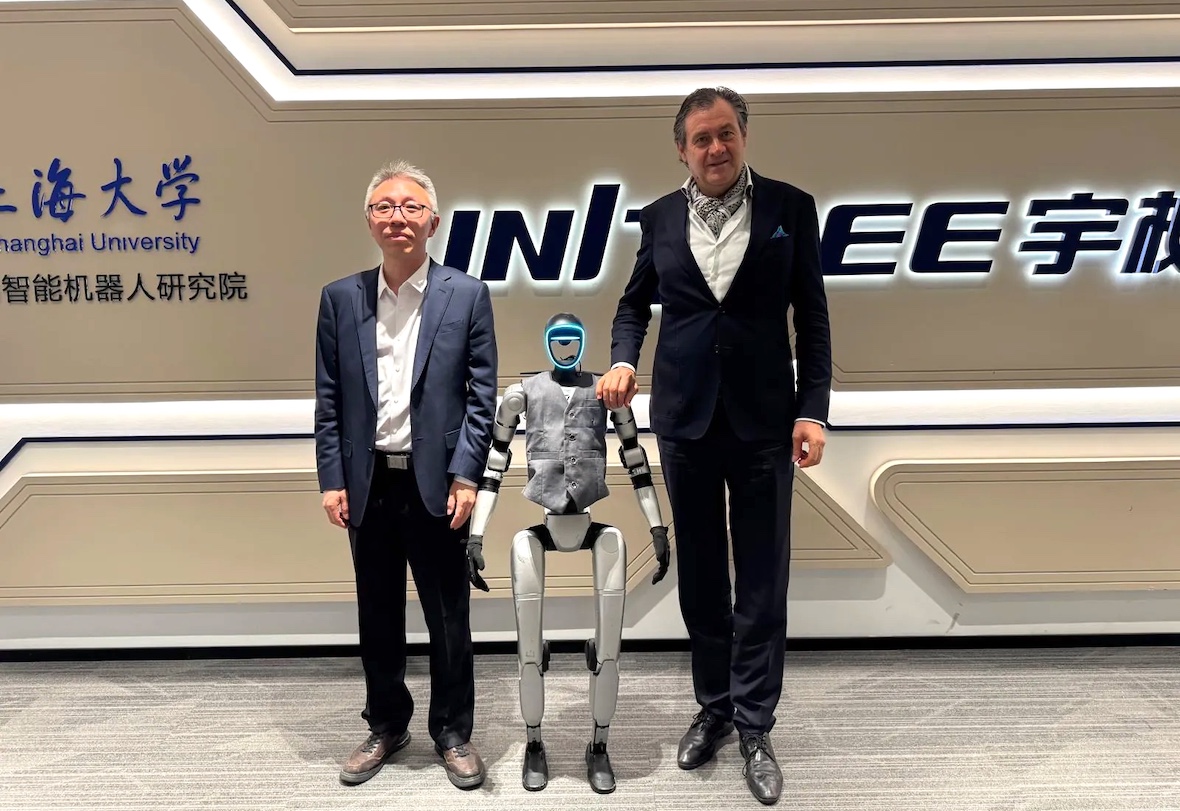 Benoît Dubuis, Director of Asinov School, with his host, Professor Chen of Shanghai University, alongside a Unitree humanoid at the Unitree Shanghai University Institute. | © Asinov School
The Asinov School in Renens, canton of Vaud, will welcome its first cohort on 18 January 2027. The 12-month program trains professionals to deploy and manage AI-powered humanoid robots, and ends with a week of immersion in Shanghai.
The Asinov School has opened applications for its first cohort, with courses starting on January 18, 2027. Launched by the Inartis and Dalle Molle foundations together with 42 Lausanne, it is presented as an international platform dedicated to embodied intelligence and humanoid robotics. The Swiss Academy of Engineering Sciences (SATW) and the Chinese Academy of Engineering (CAE) support the initiative.
The school starts from a simple premise: deployment, not engineering, is the bottleneck. Its motto is “You don’t need to build robots. You need to know how to work with them.” The program therefore teaches how to identify where humanoids create value and how to make it work in healthcare, industry, logistics, services and the public sector, rather than how to design robots.
A 12-month, project-based program
Modeled on the 42 schools, the program has no traditional classes. It relies on project-based learning, peer learning and hands-on experimentation. Flexible and self-paced, it lasts about 12 months on average, roughly six months of coursework and six months devoted to a personal project. Training begins with quadrupedal robots, and humanoids are introduced later. Pierre-Louis Cardin, Campus Lead of 42 Lausanne, says humanoid robotics requires a pedagogy based on practice, autonomy and solving real problems.
The school operates two hubs: Renens, at Station R, and Shanghai, where students spend a final week of immersion with next-generation humanoid platforms still in early development. In Shanghai, the school works with the System Integration Lab, Shanghai University and the Unitree – Shanghai University Embodied Intelligence Joint Lab, which provides access to mobile and humanoid robotic platforms.
Partners and early demand
Benoît Dubuis directs the school, with David Vandenbrouck as co-director. Its partners include the Dalle Molle Foundation, the Inartis Foundation, 42 Lausanne, SATW, the System Integration Lab, Idiap, HEPIA, HES-SO Valais-Wallis, DEFTECH, IBSA Group and the robot manufacturer AgiBot. The first cohort is limited in size, and about 20 participants had already registered, half of them sent by their employers.
The training comes as humanoid robots begin to reach the market. AgiBot humanoids, already available in Switzerland, are expected to be delivered from the end of the year at prices ranging from about CHF 30,000 to CHF 120,000, with uses in packaging, handling and logistics. Demonstrations in Renens also showed that the technology is still maturing, with falls and unpredictable interactions.
Western Switzerland’s robotics ecosystem is described in more detail in our overview for robotics companies.