Fribourg’s Biofactory Competence Center turns biotech research into scalable production
Life sciences
23 June 2026
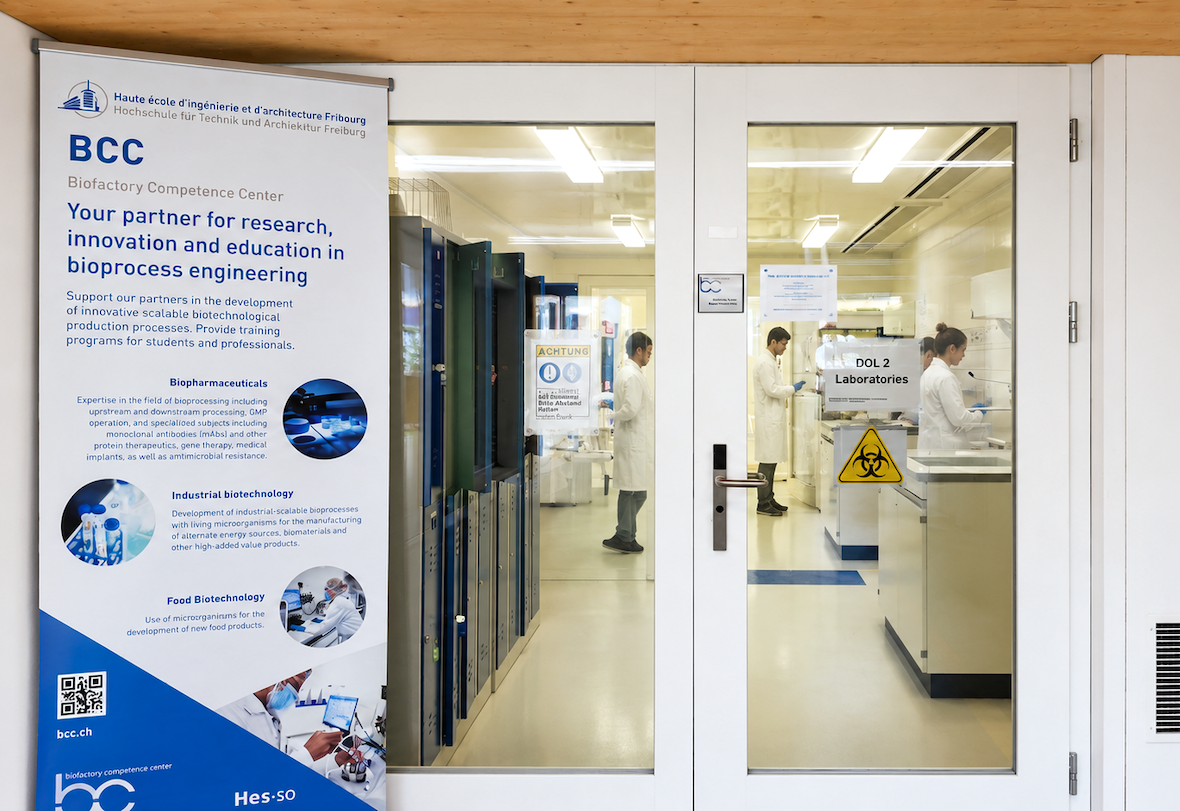 The Biofactory Competence Center, located at the Bluefactory in Fribourg, supports the development, optimization and scale-up of biotechnological production processes for academic and industry partners.
At a recent BioAlps INSIDE event in Fribourg, the Biofactory Competence Center showcased how its bioprocess expertise helps partners across Western Switzerland move from research to production, with collaborations spanning Lausanne start-up Regenosca and the CHUV.
The Biofactory Competence Center (BCC), located at the Bluefactory site in Fribourg, has become a central node in Western Switzerland’s life sciences ecosystem. Part of the School of Engineering and Architecture of Fribourg (HEIA-FR) within the University of Applied Sciences and Arts Western Switzerland (HES-SO), the center specializes in the development, optimization and scale-up of biotechnological production processes, with most of its engineers coming directly from industry. Its work spans upstream and downstream processing, from cell culture to protein purification, primarily in the biopharmaceutical field and increasingly in food biotechnology.
Operating with a compact, agile team, the BCC works with start-ups, academic institutions, and established companies through research mandates and projects funded by Innosuisse. Its portfolio reflects some of the sector’s most pressing challenges: several projects target antimicrobial resistance, including phage therapy with the CHUV and the production of endolysins with Zurich-based company Micreos, while other work covers digital twins for bioprocess optimization, developed with partners such as DataHow and Beckman Coulter, and food applications including a spirulina production process. Two collaborations in particular illustrate how the center helps bring innovation closer to patients.
The first is with Regenosca, a Lausanne-based regenerative medicine start-up founded by CEO Eva-Maria Balet, Mattias Larsson (CTO) and Ganesh Vythilingam (Chief Medical Officer). The company develops TissueSpan, an off-the-shelf implant designed to help the body heal itself, with a first indication in urethral stricture, a narrowing of the urinary tract that mainly affects men over 55. The current gold-standard treatment requires harvesting tissue from the patient’s own mouth, creating two surgical sites, while less invasive alternatives can fail in up to 80 percent of cases. Regenosca’s first-in-human trial followed five patients over two years, recording zero adverse events, seamless integration into the surgical workflow, and complete tissue healing. Since 2022, the BCC has supported the company on process optimization, scale-up and manufacturing for preclinical activities, increasing output from a single implant at a time to 30 per batch and developing a single-use mold that simplifies the transition to clean-room production. Regenosca is targeting a 75-patient trial and CE marking ahead of a planned market entry by 2030, and is currently raising a CHF 1 million seed round.
The second collaboration is with the Laboratory of Bacteriophages and Phage Therapy, led by Dr. Grégory Resch and the Cell Production Center (CPC), led by Dr. Jean-François Brunet and Dr. Laurent Carrez, at the Lausanne University Hospital (CHUV). Bacteriophages are viruses that specifically target bacteria, including strains that have become resistant to antibiotics, making them a promising tool against antimicrobial resistance. In June 2023, the CHUV became the first academic institution in the world to obtain authorization from Swissmedic to produce therapeutic phages under good manufacturing practices (GMP). The laboratory treats patients on a compassionate-use basis, isolating phages from wastewater samples and testing them against each patient’s bacterial strain, typically in combination with antibiotics. The BCC supports the optimization of this GMP production pipeline, helping to determine the ideal timing for adding phages to maximize yield, and exploring lyophilization to improve storage.
BCC’s key industry partner Cytiva, which has a European office in Fribourg and has played a foundational role since BCC’s inception (originally as Pall Life Sciences), is also involved as a research partner for the development of advanced and scalable purification technologies for bacteriophages intended for therapeutic use, in collaboration with BCC and CHUV.
Across both cases, a common theme emerged: the value of Western Switzerland’s compact, well-connected ecosystem. With Fribourg positioned at the linguistic crossroads of the country and barely two hours by road from its partners, face-to-face exchanges, which are essential in the early stages of technology transfer, become fast and frequent. It is this proximity, combined with deep technical expertise, that allows the region to turn promising research into production-ready processes.